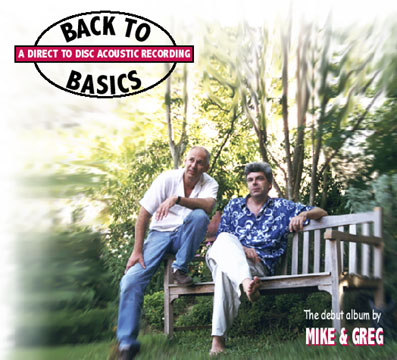
1. Carolina In My Mind. James Taylor (03:30)
2. Blossom, James Taylor (02:34)
3. Streets of London, Ralph McTell (04:01)
4. May You Never, John Martin (02:33)
5. First Song, Ralph McTell (02:25)
6. You've Got A Friend, Carole King (03:44)
7. Crazy Man Michael, Fairport Convention (04:23)
8. Scarborough Fair, Trad., arr. Paul Simon (03:35)
9. You Can Close Your Eyes, James Taylor ((02:43)
10. Yesterday, The Beatles (02:13)
11. Chelsea Morning, Joni Mitchell (02:46)
BACK TO BASICS - THE STORY
Mike and I knew each other from working in the same Gold Coast university for probably two years before a chance discovery in 1994 that we both played guitar and sang. We are both old enough to have experienced the promise of musical collaboration many times before and usually been disappointed. Being optimists (of varying degree) we still arranged a jam but were both privately rather sceptical that we’d "get on" musically. We each had a personal set of songs developed over almost 30 years of irregular bouts of playing, so we had to discover what each was really into. I suggested Mike start off and he gave a rendition of Blossom (James Taylor). This was a tad amazing as my first song was going to be Blossom too, with the same chords but using a capo played five frets (semitones) higher. It became immediately apparent that Mike’s rich lead voice and strong 6-string Martin blended with my 12-string Eko and preference for harmonies.
Fired up, it was now simply a matter of selecting songs that we both liked. We both offered a large number but the other quickly scythed through them for one reason or another. Sometimes the music was lovely but the lyrics were banal or simply not what we wanted to sing about (saccharine love songs at our age just don’t cut it anymore!). Other songs were great but became boring after a few repetitions. Some were difficult to enhance or bend to our style, offered little opportunity for harmonies or guitar fills, required a singing range beyond our abilities, or simply one of us didn’t like! Despite this, we developed a core of songs that we could sing over and over and still enjoy the material.
Unfortunately, once we honed a set that could be performed, Mike followed a job to Brisbane (90km away) but we maintained contact, albeit sporadically. He was lucky in having a new work colleague offer to record him in an anechoic room (for recording language tapes) in Brisbane using good quality recording equipment. The resulting 5-track CD sounded great and Mike suggested that we resume our duets and commit our repertoire to disc.
In setting out to record a sample of our collaboration we both discussed the dearth of raw live music these days. In our formative years folk clubs and wine bars were the rage and they were never short of aspiring players; simple guitar and voice often without the benefit of any amplification. Today, most one and two-person performing acts use backing tracks. While giving a sophisticated sound and sometimes being perfect renditions of the original recording, this often provides a mechanical and repetitious performance (and removes the performer’s risk other than the tape/disk/computer failing). The performer also has no chance to extemporise or change emphasis, as the backing rigidly propels the performance. Mike and I sound different everytime we perform these songs – though perhaps this is because we never practice them to perfection! So we were determined to avoid soulless backing, and we also decided to do without other recording tricks such as recording guitars first and then singing over the top, double-tracking to enhance our voices, singing lead then re-recording with harmony, or splicing the best bits from multiple takes.
Anyway, our first attempt saw us record 9 duets and 7 solos in a single afternoon (February 2000) and we were very pleased with the outcome – we sounded extraordinarily relaxed and the ambience on CD was like a living room. There were some very noticeable guitar errors (we felt too embarrassed to do re-takes as the engineer was volunteering his time on a Saturday) and also annoying scratches/pops at the end of every track introduced in the mixing or CD burning process. Some of the performances I would rate better than on the current CD you are presently playing but the overall sound was not a stand out. However the success of that first experiment, ending with a playable CD in our hands, rekindled our musical spirits and we decided to dip hands in pockets and repeat the exercise in a professional studio later in the year. The only weakness in the plan was that we continued to have precious little time to practice–let alone practice together. Through a chance meeting (in a supermarket of all places) with someone who used to run a local music shop, I contacted a Gold Coast studio run by Adrian Stuckey, the guy who used to sell guitars in that music shop. Adrian listened to our initial CD and liked the material and the style and agreed to record us and produce a sound that would better suit the modern sophisticated ear ... we now "expect" a certain minimum sound characteristics when listening to music CDs.
We rehearsed each song a couple of times before the recording session. Before the take, we’d do a couple bars to get the groove for that song then just get straight into it after a count of four. We recorded in a fairly random order (using our proprietary "what shall we do next?" method).
We recorded five songs and Mike’s solo in the first 3-hour session, a further 5 duets in a second 3-hour session and mixed the CD in another. We are happier with the better quality of the sound achieved and can only sing the praises of Adrian Stuckey and BigNote Productions for the result. Yes there are still bum notes but we have to be realistic about what can be achieved with so little time to practice and record. Three hours may seem a long time to some but includes setting up our positions, the mic, setting recording levels, re-takes, and re-tuning ... neither of the studios we used had "silent" airconditioning as it costs a small fortune to install, so recording had to be done with the air-con OFF. Believe me, three men in a few cubic metres raises the room temperature very quickly and airconditioning was needed at the end of each song. However this cycle of heat and humidity played havoc with string length (that old coefficient of expansion has real-world applications!) and we were constantly re-tuning.
After receiving the first rough mix of our first session (to check for major errors) it became apparent that Adrian himself had become a little corrupted by the recording work he had been doing. Ours was the first all-acoustic performance he had recorded and the rough mix didn’t really sound like Mike and me at all – you could barely hear the harmonies and Mike’s voice had lost its bass earthiness. I wasn’t a happy chappy. Anyway, as there was to be long break due to Mike’s work commitments, I commenced on my solo CD and used that one-on-one opportunity to convince Adrian of the sound I wanted to achieve. Adrian is a professional musician and was quick to pick up on the request and admitted that he had become overconditioned to the electronic in-your-face style that all his other clients demanded, including backing voices which are "way back". The successful mixes achieved with my solo acoustic tracks were applied to the duets, and I hope you enjoy the richer texture achieved including more or less "equal" vocals and guitars.
You will hear the raw full take on every song, as if we were playing in front of you. The only concession to technology is the use of some reverb and compression (discussed in the Mixing notes). We both would like to change some aspects of the recordings. There are mistakes of course but overall we are happy that the result gives an honest recording of us getting back to basics.
All songs were recorded at BigNote Studio in Burleigh on the Gold Coast. Tracks 3,4,7,8, 9 and 11 were done in the first session. Each of us was placed in a separate booth with a mic for voice and another for guitar, and headphones to hear what the other was playing and singing. While this is the norm in the professional world to minimise the crossover between performers’s mics, we both found it physically uncomfortable as the headphones make your ears warm very quickly. It also felt unnatural as we no longer had visual clues as to what the other was doing (Mike often sings with his eyes closed and I watch his mouth and body movements (purely professional m’lud) to sync my parts. As a result we opened the door between the booths so I could see him although the soundproofed walls still absorbed many sounds. For the second session, we introduced a Dean Markley pickup each in addition to the two mics each as this had turned out to be a boon for mixing for all instrumentals on my solo CD (which took place between the duet sessions). All the duets and Mike’s solo on track 7 were direct to disc recordings. We did not record parts separately, or multi-track, or use electronics to synchronise our guitars and voices. What you hear is as if we were playing live in front of you.
The key to the mixing was to give the tracks a broader and more even quality than we achieved first time around in Brisbane when everything was recorded "flat" (no reverb) and without any shaping of the stereo - I always found there was a bit of an aural "hole" in the centre of the stereo mix. Through trial and error we found a good balance of reverb for guitars and voices with each us being placed predominantly on one side (with Mike on the left) but also spreading to just the other side of centre, thus providing a rich spread of sound from left to right. This is particularly noticeable on the guitar on Mike’s solo where string resonance seems to waft from side to side. These settings were applied to all inputs on all tracks with minor adjustments as overall sound tends to change dependent upon keys and also between sessions (there were 4 inputs in session 1 vs. 6 inputs in session 2). We were also introduced to the wonders of compression. This is the technique which causes TV adverts to sound louder than the programs without actually having the necessary taller waveform. Compression works mathematically by lifting the lower parts of the waveform, thus raising the average loudness of the sound. If used too much. it is impossible to have quieter passages of music, but if applied appropriately (like we have, I hope) to our guitars, it gives them more "punch", and allows the finer elements to be heard above ambient noise such as air-conditioning or in a car..
Track order is a hard choice but amazingly, once made, seems natural and it is hard to imagine any alternative. The final order is almost identical to the Brisbane recording which proved to work well. However "Carolina on my Mind" has been moved to the front because it is a good and immediate advert for our style. "First Song" and "Crazy Man", which are new, were placed where they contrast well. The dying ringing notes of "Crazy Man" also leads nicely into the opening ringing riffs of "Scarborough Fair".
The whole mixing process took only 3 hours. Adrian was a little stunned by the speed of both our recording and the mixing. He is used to clients who take several days to record and mix a single track.
Mike: Working collaboratively on a CD requires a certain amount of tolerance from all parties concerned. This is especially true of anyone who is game to work on a project with me! So thank you Greg for your humour, enthusiasm, and all the times you reminded me of the fingering for D9 and Esus4 (etc. etc.) without blowing a fuse!
Greg: The only frustration I felt was that time was shackling us but the exhilaration of two voices and two guitars playing a good song well is simply too hard to explain in words. It’s just a visceral and sensory pleasure for me that makes all the effort worthwhile and if we can have brought a different musical interpretation to these great songs, then so much the better. I hope the original composers, their publishers, record companies et al will not object to our homage–we do not wish or intend to make any money from this venture.
Both: Our collaboration was musical but it also provided a rare and pleasant "male bonding" opportunity where we could share our other trials and tribulations over a cup of tea or a cold beer. The whole experience was like a stress valve - a valuable commodity for anyone with busy career and family commitments. Now that the CD is finished we both share a sense of relief; another demon has been laid to rest. Our next goal is to now write some material ourselves. We’ll keep you posted.